
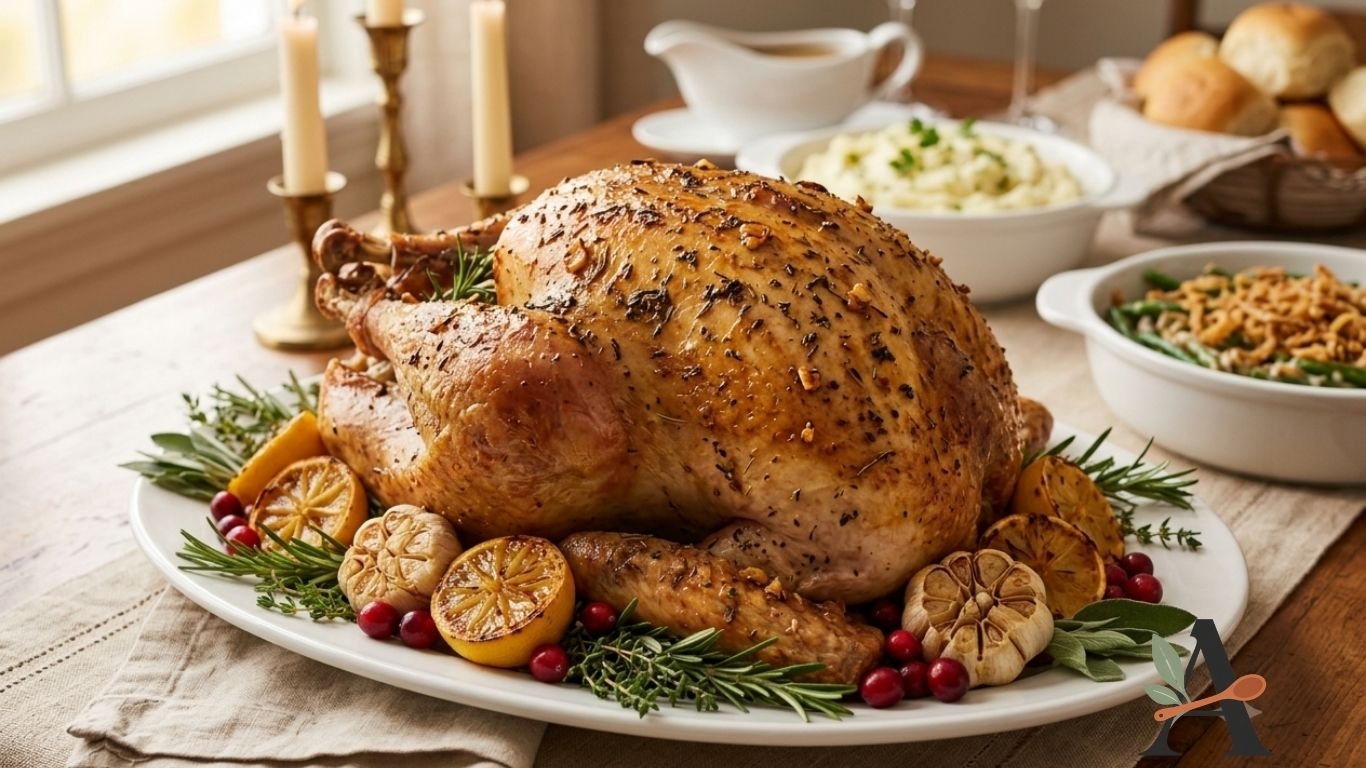
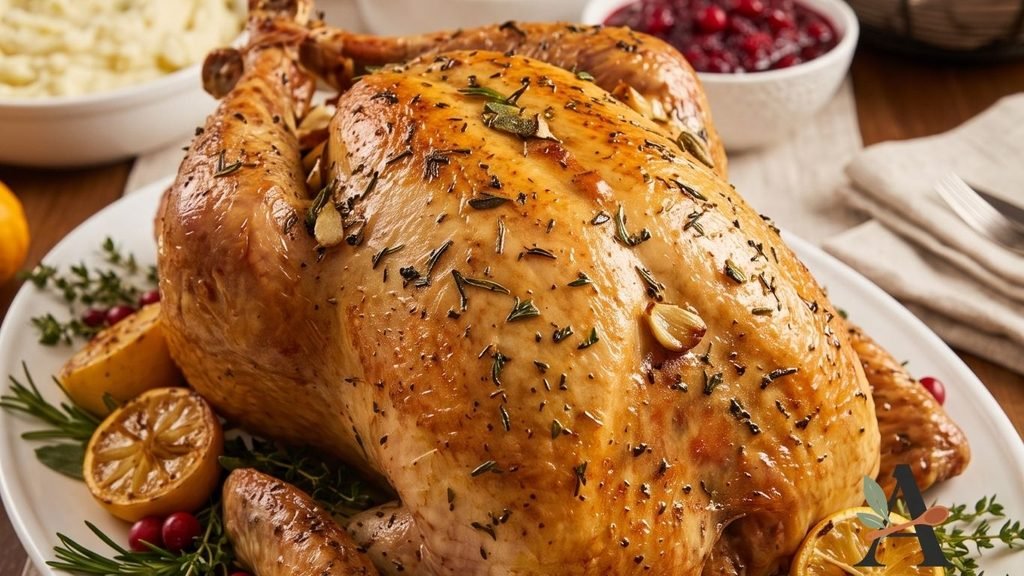
This herb butter roast turkey has golden skin, juicy meat and plenty of garlic, rosemary, thyme and sage flavour.
Softened butter is spread underneath the breast skin as well as over the outside of the turkey. The butter beneath the skin seasons the meat directly, while the outside layer encourages browning.
The turkey roasts over aromatic onion, lemon and herbs, creating flavourful pan juices that can be turned into homemade gravy.
Important Turkey Safety Information
Use a reliable food thermometer rather than judging doneness by colour or cooking time.
The USDA recommends roasting turkey at an oven temperature no lower than 325°F. A whole turkey is safely cooked when the thickest part of the breast, innermost part of the thigh and innermost part of the wing each reach at least 165°F. USDA turkey roasting guidance.
Why You’ll Love This Roast Turkey
- Juicy, well-seasoned meat.
- Golden, flavourful skin.
- Garlic herb butter under and over the skin.
- Suitable for Thanksgiving and Christmas.
- Creates pan drippings for homemade gravy.
- Uses familiar fresh herbs.
- Roasts without complicated equipment.
- Includes thawing and cooking guidance.
- Can be seasoned one day ahead.
- Makes excellent leftovers.
Ingredients You’ll Need
For the Turkey
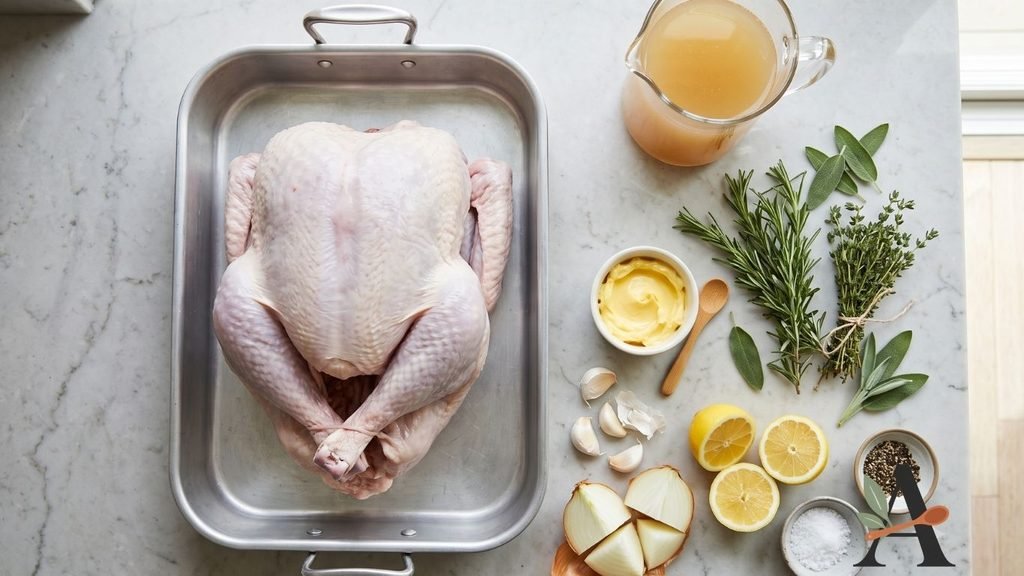
- 1 whole turkey, approximately 12–14 pounds.
- 2 teaspoons salt, adjusted according to the turkey’s packaging and brining.
- 1 teaspoon ground black pepper.
- 1 large yellow onion, quartered.
- 1 lemon, quartered.
- 1 head of garlic, cut across the middle.
- 4 fresh rosemary sprigs.
- 8 fresh thyme sprigs.
- 6 fresh sage leaves.
- 2 cups low-sodium chicken or turkey stock.
For the Herb Butter
- ¾ cup unsalted butter, softened.
- 4 garlic cloves, finely minced.
- 1 tablespoon chopped fresh rosemary.
- 1 tablespoon chopped fresh thyme.
- 1 tablespoon chopped fresh sage.
- 1 teaspoon finely grated lemon zest.
- ½ teaspoon ground black pepper.
- ½ teaspoon salt, adjusted according to the turkey.
Ingredient Notes
Turkey: Use a completely thawed, unstuffed turkey. Check the packaging to determine whether it has been brined, injected or pre-seasoned.
Butter: Softened unsalted butter is easiest to spread and provides better control over seasoning.
Garlic: Finely mince or grate the garlic so it mixes evenly into the butter.
Fresh herbs: Rosemary, thyme and sage provide classic holiday flavour. Dried herbs may be used in smaller quantities, but the result will differ.
Lemon: Lemon zest flavours the butter, while lemon quarters placed in the cavity add aroma.
Stock: Stock prevents the pan drippings from scorching and provides additional liquid for gravy.
Salt: Reduce or omit added salt when using a kosher, self-basting, injected or pre-brined turkey.
How Much Turkey Do You Need?
A useful guide is:
- 1–1¼ pounds per person: Moderate servings with some leftovers.
- 1½ pounds per person: Generous servings and plenty of leftovers.
A 12–14-pound turkey generally serves approximately 8–10 people, depending on portion size and the number of side dishes.
How to Thaw a Frozen Turkey Safely
Refrigerator thawing is the simplest method.
Keep the wrapped turkey on a rimmed tray in a refrigerator set at 40°F or below. Allow approximately 24 hours for every 4–5 pounds.
A 12–14-pound turkey will normally require approximately three days to thaw. Once refrigerator-thawed, it may remain refrigerated for another one or two days before cooking. USDA safe thawing guidance.
Do not thaw a turkey on the kitchen counter.
Should You Wash a Raw Turkey?
No. Washing raw turkey can spread contaminated droplets around the sink, worktops and nearby food.
Remove the turkey from its packaging, discard the packaging carefully and pat the surface dry with disposable paper towels.
Clean and sanitise any surfaces contacted by raw turkey.
How to Make Herb Butter Roast Turkey
Step 1: Bring the Turkey From the Refrigerator
Remove the completely thawed turkey from the refrigerator approximately 30–45 minutes before preparing it.
Do not leave raw turkey at room temperature for more than necessary.
Remove the neck and giblet packet from the cavities. Reserve them for stock or gravy if desired.
Step 2: Prepare the Oven and Roasting Pan
Position an oven rack in the lower third of the oven.
Preheat the oven to 325°F.
Place a roasting rack inside a large, sturdy roasting pan.
Step 3: Dry and Season the Turkey
Pat the turkey thoroughly dry, including inside the cavities.
Place it breast-side up on the roasting rack.
Season the cavity lightly with salt and black pepper, accounting for any seasoning already present in the turkey.
Step 4: Make the Herb Butter
Combine the softened butter with:
- Minced garlic.
- Chopped rosemary.
- Chopped thyme.
- Chopped sage.
- Lemon zest.
- Salt.
- Black pepper.
Mix until the herbs and garlic are evenly distributed.
Step 5: Apply the Butter Under the Skin
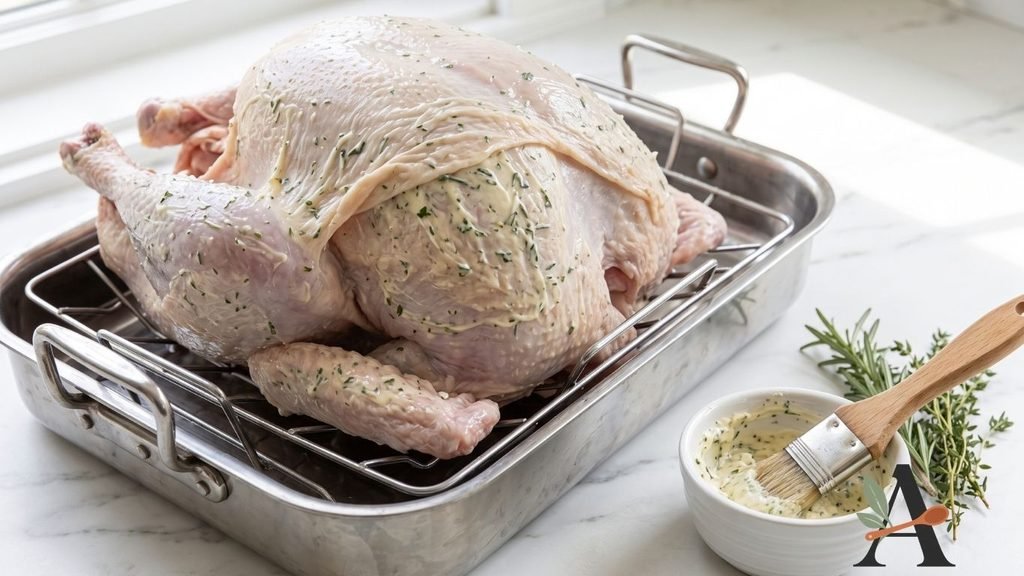
Beginning near the neck opening, gently slide your fingers underneath the skin covering the breasts.
Work slowly to separate the skin without tearing it.
Spread approximately half of the herb butter directly over the breast meat beneath the skin.
Smooth the skin back into place.
Step 6: Butter the Outside
Spread the remaining herb butter evenly over the turkey’s breast, legs and wings.
The butter should form a thin, even layer rather than thick patches.
Step 7: Add the Aromatics
Place some of the onion, lemon, halved garlic and whole herb sprigs loosely inside the cavity.
Do not pack the cavity tightly.
Arrange the remaining onion and herbs beneath and around the roasting rack.
Step 8: Position the Turkey
Tuck the wing tips underneath the turkey to reduce burning.
Tie the legs loosely together with kitchen twine if desired. Do not bind them tightly, as air should still circulate around the thighs.
Pour the stock into the bottom of the roasting pan without pouring it over the buttered skin.
Step 9: Roast the Turkey
Roast the turkey uncovered at 325°F.
A 12–14-pound unstuffed turkey generally takes approximately 3–3¾ hours, but this is only a planning guide. Oven performance, turkey shape and starting temperature can change the cooking time.
Begin checking the temperature before the earliest estimated finishing time.
Step 10: Monitor the Browning
Rotate the roasting pan once during cooking if your oven browns unevenly.
If the breast becomes sufficiently golden before the turkey is cooked, cover the breast loosely with aluminium foil.
Add more stock or water to the pan if the drippings begin to scorch.
Avoid opening the oven repeatedly, as this releases heat and extends the cooking time.
Step 11: Check the Internal Temperature
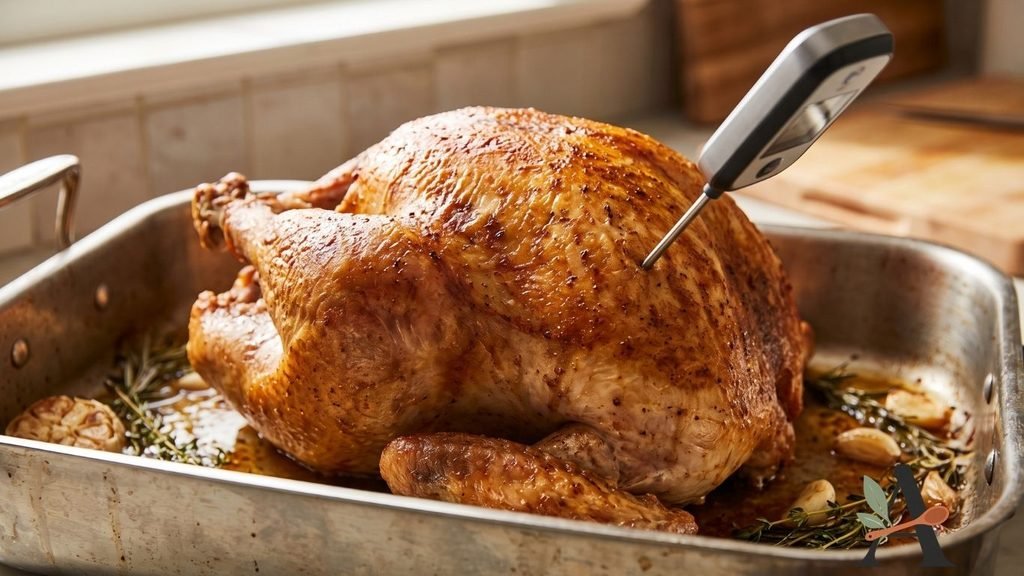
Insert an instant-read thermometer into:
- The thickest part of the breast.
- The innermost part of the thigh.
- The innermost part of the wing.
Avoid touching bone because it can produce an inaccurate reading.
Continue roasting until all three areas reach at least 165°F.
Step 12: Rest the Turkey
Carefully transfer the turkey to a clean carving board or serving platter.
Tent it loosely with aluminium foil.
Rest for approximately 30–45 minutes before carving.
Resting allows the juices to redistribute and gives you time to prepare gravy using the pan drippings.
Approximate Turkey Roasting Times
These estimates apply to a completely thawed, unstuffed turkey roasted at 325°F:
| Turkey weight | Approximate roasting time |
|---|---|
| 8–12 pounds | 2¾–3 hours |
| 12–14 pounds | 3–3¾ hours |
| 14–18 pounds | 3¾–4¼ hours |
| 18–20 pounds | 4¼–4½ hours |
| 20–24 pounds | 4½–5 hours |
Cooking time is an estimate only. Always confirm doneness with a food thermometer.
Tips for a Juicy Roast Turkey
Thaw It Completely
A partially frozen turkey cooks unevenly and requires considerably more time.
Check Whether It Is Pre-Brined
Packaging terms such as “self-basting,” “contains a solution” or “kosher” may indicate that salt has already been added.
Dry the Skin Thoroughly
Moisture prevents efficient browning. Pat every exposed surface dry before applying the butter.
Put Butter Under the Skin
Butter beneath the skin flavours the breast meat directly instead of seasoning only the exterior.
Use a Roasting Rack
Elevating the turkey allows hot air to circulate and prevents the underside from sitting in liquid.
Do Not Rely on the Pop-Up Timer
Use a reliable instant-read or probe thermometer to check several parts of the turkey.
Protect the Breast When Necessary
Cover the breast loosely with foil if it browns too quickly.
Rest Before Carving
Cutting immediately allows more juice to escape onto the board.
How to Get Crispy Turkey Skin
For better browning:
- Thaw the turkey completely.
- Pat the skin thoroughly dry.
- Leave the turkey uncovered in the refrigerator overnight, if practical.
- Apply a thin, even coating of butter.
- Do not baste repeatedly.
- Keep the roasting pan uncovered.
- Add foil only when the skin is sufficiently brown.
Opening the oven to baste lowers the temperature and introduces moisture to the skin.
Should You Stuff the Turkey?
For simpler and more predictable cooking, bake stuffing separately in a casserole dish.
Stuffing cooked inside the turkey must also reach at least 165°F. This can make it more difficult to cook the meat and stuffing evenly.
Use the cavity for loose aromatics such as onion, lemon and herbs instead.
Easy Roast Turkey Variations
Garlic Herb Turkey
Increase the garlic and add fresh parsley to the butter.
Citrus Herb Turkey
Add orange zest to the butter and place orange quarters inside the cavity.
Rosemary Butter Turkey
Use additional rosemary for a stronger piney, savoury flavour.
Cajun Roast Turkey
Replace the traditional herbs with a salt-controlled Cajun seasoning blend.
Maple Butter Turkey
Add a small amount of maple syrup to the butter. Monitor browning carefully because sugar can darken quickly.
Dry-Brined Turkey
Season the turkey with salt in advance and refrigerate it uncovered. Only use a tested salt quantity based on weight, and do not dry-brine a pre-salted turkey.
How to Carve a Roast Turkey
- Remove the kitchen twine.
- Pull one leg away from the body.
- Cut through the joint to remove the leg and thigh.
- Separate the drumstick from the thigh.
- Remove the wing.
- Slice down alongside the breastbone.
- Follow the ribcage to remove the breast in one piece.
- Slice the breast crosswise.
- Repeat on the opposite side.
- Arrange the meat on a warm serving platter.
Use a sharp carving knife and a stable board with a groove for collecting juices.
What to Serve With Roast Turkey
Serve herb butter turkey with:
- Turkey gravy from drippings.
- Creamy mashed potatoes.
- Classic Thanksgiving stuffing.
- Homemade cranberry sauce.
- Green bean casserole.
- Sweet potato casserole.
- Honey glazed carrots.
- Garlic Parmesan Brussels sprouts.
- Homemade dinner rolls.
- Creamy baked mac and cheese.
For a complete holiday menu, serve it with Turkey Gravy From Drippings, Classic Thanksgiving Stuffing, Homemade Cranberry Sauce and Creamy Mashed Potatoes.
How to Prepare the Turkey Ahead
One day before roasting:
- Confirm that the turkey is completely thawed.
- Remove the neck and giblets.
- Pat the turkey thoroughly dry.
- Prepare and apply the herb butter.
- Place the turkey uncovered on a rack over a tray.
- Refrigerate overnight.
Leaving it uncovered helps dry the skin.
Keep raw turkey on the lowest refrigerator shelf so it cannot drip onto other food.
How to Store Leftover Turkey
Carve the remaining meat from the bones and transfer it to shallow airtight containers.
Refrigerate within two hours of cooking.
Use refrigerated cooked turkey within 3–4 days, or freeze it for longer storage.
Can You Freeze Cooked Turkey?
Yes. Divide the cooled meat into meal-sized portions.
Add a small amount of stock or gravy to help protect it from drying out.
Place it in freezer-safe containers and freeze for up to three months for best quality.
Thaw overnight in the refrigerator.
How to Reheat Roast Turkey
Arrange sliced turkey in a baking dish.
Add a small amount of turkey stock or gravy and cover tightly with foil.
Reheat at 325°F until thoroughly hot.
Individual portions can be reheated in the microwave with a spoonful of stock.
Frequently Asked Questions
How long does a 12-pound turkey take to cook?
An unstuffed 12-pound turkey roasted at 325°F generally requires approximately 2¾–3 hours. Use a food thermometer rather than time alone.
What temperature should a turkey reach?
The thickest breast, innermost thigh and innermost wing should each reach at least 165°F.
Should I cover the turkey while roasting?
Roast it uncovered initially. Cover the breast loosely with foil only if the skin becomes brown before the meat is fully cooked.
Should I baste the turkey?
Basting is optional. Repeated basting opens the oven and can soften the skin without guaranteeing juicier meat.
Can I use salted butter?
Yes, but reduce the additional salt, particularly if the turkey has already been brined or injected.
Why is my turkey dry?
Common causes include overcooking, relying only on estimated cooking time and carving without resting.
Can I prepare the herb butter ahead?
Yes. Mix and refrigerate it for several days, then soften it before spreading.
How long should turkey rest before carving?
Rest a large whole turkey for approximately 30–45 minutes, tented loosely with foil.
Herb Butter Roast Turkey Recipe Card
Preparation time: 30 minutes
Cooking time: Approximately 3–3¾ hours
Resting time: 30–45 minutes
Total time: Approximately 4½–5 hours
Servings: 8–10
Course: Main Dish
Cuisine: American
Method: Roasting
Ingredients
Turkey
- 1 completely thawed whole turkey, 12–14 pounds.
- 2 teaspoons salt, adjusted as necessary.
- 1 teaspoon black pepper.
- 1 yellow onion, quartered.
- 1 lemon, quartered.
- 1 head garlic, halved.
- 4 rosemary sprigs.
- 8 thyme sprigs.
- 6 sage leaves.
- 2 cups low-sodium turkey or chicken stock.
Herb Butter
- ¾ cup softened unsalted butter.
- 4 garlic cloves, finely minced.
- 1 tablespoon chopped rosemary.
- 1 tablespoon chopped thyme.
- 1 tablespoon chopped sage.
- 1 teaspoon lemon zest.
- ½ teaspoon black pepper.
- ½ teaspoon salt, adjusted as necessary.
Instructions
- Confirm that the turkey is completely thawed.
- Preheat the oven to 325°F.
- Position a rack inside a large roasting pan.
- Remove the neck and giblets.
- Do not wash the turkey.
- Pat the turkey thoroughly dry.
- Mix all herb butter ingredients.
- Gently loosen the skin over the breast.
- Spread half the butter beneath the skin.
- Spread the remaining butter over the exterior.
- Place the onion, lemon, garlic and herbs loosely inside the cavity.
- Tuck the wings underneath the turkey.
- Tie the legs loosely, if desired.
- Pour the stock into the roasting pan.
- Roast breast-side up at 325°F.
- Cover the breast loosely with foil if it browns too quickly.
- Begin checking before the estimated finishing time.
- Cook until the breast, innermost thigh and innermost wing each reach at least 165°F.
- Transfer the turkey to a clean board.
- Rest loosely covered for 30–45 minutes.
- Carve and serve.
Recipe Notes
- Adjust the salt for a brined or pre-seasoned turkey.
- Cooking times are estimates only.
- Use a reliable food thermometer in several locations.
- Bake stuffing separately for easier, more predictable cooking.
- Refrigerate leftovers within two hours.
- Test the complete recipe before confirming precise timing and yield.